domingo, 5 de junio de 2016

Killers in the Rye

The Catcher in the Rye, written by J.D. Salinger , is a work piece that, in the raw words of a 16 year old boy, deals with topics such as confusion, maturity, distress, among others; however, one of the facts that caught my attention the most (besides the language used, pretty unfamiliar, although close and catchy) is how our protagonist, Holden Caulfield, deals with hypocrisy during the whole reading.

Phonies. Let’s talk about phonies in this one. Holden clarifies that he is surrounded by phonies; false people with false living, falsehood everywhere. To make it clearer, on the very first page he states that his own brother used to be a terrific writer, but now his just a sellout; a prostitute of Hollywood. He even says that movies (probably an observation not only of the character itself but from the writer) are false for showing fake roles, fake emotions; and the people at movies who laughed at stuff that was not funny at all were phonies too. However, as a result of all his experiences on his narration, Holden kind of retreat his feeling of criticizing everything as false in the last fragment of the novel.

Overall, Holden Caulfield results to be one of the most loved character in American literature, as well as The Catcher in the Rye one of the most read novels in the mentioned country. Notwithstanding, there are some special moments in history were this book was controversial, and not precisely for its message, but for its reception and backlash.

It’s well-known the moment in which a man, allegedly insane, shot dead a famous artist, and waited for the police to arrest him while reading The Catcher in the Rye in the crime scene; I’m talking about Mark David Chapman, who on December 8th, 1980, discharged his weapon against John Lennon, at the entrance of the building where Lennon resided. Lennon was a musician and peace activist; Chapman, a huge follower of Holden Caulfield’s image and thinking. Lennon was an atheist, as he expressed on his work; Chapman, a “born again” Christian. Mark Chapman thought that Lennon was a phony for being an activist of peace and social justice, and yet he did not  followed the path of God, which had no sense for Chapman.

After the murder, Chapman sat near Lennon and proceeded to read The Catcher in the Rye, in the wait for his arrest. When the police confiscated his book, they found the sentence “this is my statement”, signed by Holden Caulfield, exposing his obsession of emulating the fictional character.

But not only Chapman was obsessed by this character: John Hinckley, who tried to kill President Ronald Reagan, happened to have a copy of the novel on the coffee table of his house, found by the police. Robert John Bardo, who had mental issues, who also had little to none tolerance to falsehood, and  who stalked Madonna and the actress Samantha Smith, found the American actress and model Rebecca Schaeffer alone in her domicile and killed her in 1989, having a copy of the book with him on the crime scene, the same as Chapman did.


We cannot say that The Catcher in the Rye is a book that encourages people to be murderers; if that would be the case, there should be hundred or million cases similar to what happened with Chapman, Bardo or Hinckley. But after reading the book, which may be the overall factor that triggered this behavior, and consequently these mentioned events?

References:
http://www.goodreads.com/topic/show/1965201-introducing-the-catcher-criminals
http://www.hiddenmysteries.org/conspiracy/reststory/fbirye.html

The Jimmy inside us


"Look Back in Anger" by John Osborne is a play in which there is developed a story that takes place in a flat in Midland Town. In the story there are 3 main characters, Allison who is Jimmy’s wife and who’s personality is described in the play as “Hers is the most elusive personality to catch in the uneasy polyphony of these three people” (p.10), Cliff that is described by the author as relaxed and easy, and Jimmy which to my mind is the most interesting one. All of them have different personalities which are shown throughout the story. However, there is only one of those personalities that really caught my attention, Jimmy’s.


On the one hand, Jimmy is very well known because of his critics and personality, as the author expresses, “He is a disconcerting mixture of sincerity and cheerful malice, of tenderness and freebooting cruelty” (p.9). He is always expressing his feelings and his discontent in relation with different aspects, from society, politics, newspapers, religion to even his wife Allison, and as you may noticed he do it in a very special way, Jimmy uses a sarcastic humour that is also something very characteristic of his personality.
On the other hand, most of us may think (that is something that happened to me while reading the play and watching the movie) that Jimmy is a very selfish man, that he cannot think in anything else than his own opinion and point of views, that he is always looking for the worst part of the things and the life and that he is not happy at all.

But, have you ever thought in the possibility that all of us have that Jimmy inside us? Have you ever thought about how many times we make critics in just one day? I thought about it, and it is true, there is that Jimmy inside that forces us to be critical about life, and that is present for instance when we criticize the society, when we try to persuade someone putting our opinion first or maybe when we disagree with something or someone and we are capable of having a fight if it is necessary, there is that Jimmy controlling our minds and mouths.

We as human beings are always criticizing, and this could be due to the fact that we have developed this “critical thinking” so we know what may be wrong or right (or what we think that is in that way) and this could be beneficial for us. Nevertheless, it is most of the time detrimental for us, people tend to return us the critics that we may make and that is the moment in which we lose friends or made enemies. So as I mentioned before, we have that mental patterns that give us the ability to make critics, to show our opinion emphasizing all the points that we think are important, all that with the purpose of establish our opinion over others’.

Notwithstanding, and from a different point of view, how would life be without criticism? Maybe that is what makes us humans; critics are something that helps us to change the world, because one opinion in isolation is not as strong as an opinion that was built with the help of lots of people that are in the same posture. If we do not criticize the issues that are important and that are transversal to our specie we will be hermits soon.


Talking about another important aspect of that character, what about the Beat Generation? I believe that Jimmy qualifies perfectly with a specific characteristic of the movement; Jimmy, from my point of view is a pseudo anarchist, we can interpret that because he is always against the system, against the models that the rest of the people follow and against everything that disagrees with his posture. I consider him a brave man, due to the fact that he is not afraid of what other people may think about him or his opinions even if those are the worst thing ever. Nonetheless, I have also another vision related with that, and that is as we have that critical thinking mentioned before, we are also humans and we should live in communities without being pseudo anarchists, following certain patterns in order to develop the sense of belonging, so in that way we can grow and continue with our evolution.


Finally, and as a general thought, being critical is a special feature of human beings, it is something that characterize us and that can also classify us according to our preferences or visions of life. However, if we want to be critical we have to do it in a respectful way considering that there are other opinions that may be stronger than ours and that could be even more accurate than ours. Is for that reason that we have to embrace our inner Jimmy but establishing limits, otherwise we are going to suffer the consequences of being super critical and selfish with our opinions.


References
Osborne, J. (1957). Look Back in Anger. New York: Penguin Group Inc.


"Holden Caulfield: an advocate of honesty"

The Catcher in the Rye, one of Salinger’s masterpieces, tells us the painful and sad story of Holden Caulfield, a sixteen years old boy that was expelled from school because of his poor academic performance, and who is also trying to survive on this adult world of decadency that is being dominated by cruelty and artificiality. What a pity! Poor Holden… I am sure you thought the same at first, didn’t you? But let’s take a look. 

Holden Caulfield may be seen as a worldwide symbol of adolescence that tries to represent how difficult is for teenagers to overcome difficulties of the adult world, where nobody seems to care about them. Has this ever happened to you? That’s for sure. Throughout the novel, Holden seems to be excluded from the world around him, which may be labelled as a typical teenage feeling.

The Catcher in the Rye tries to expose a common situation among adolescents. However, what really makes this novel unique is the way in which the  is told. Salinger, by using the stream of consciousness style to narrate, looks that readers engage themselves into Holden’s mind, into his own way of seeing life. In this way, we are also able to notice how the protagonist of the story is frequently changing his thoughts. But that’s just normal, right? After all, adolescence is like a synonym of confusion. Yet, not all people think the same way and Holden’s actions make us feel like he is not just confused but most of the times he is contradictory. 

Holden’s main concern in life is to protect children and their innocence, since adulthood is full of hypocrisy. During the entire novel, Holden struggles against growing up and refuses to become part of a world that is so controlled by falseness.  There is no problem with that, right? He is just a boy who is trying to create a world of honesty and happiness in which children can remain innocent and perfect. What a hero! But wait, maybe we should start analyzing him, since it seems that Holden does not always appear to be an advocate of truth.

The first thing that lead us to believe that Holden does not fit the image of an idol is the way in which he refers to people. As Holden feels surrounded by dishonesty and false pretenses, he is always criticizing those who are not what they appear to be, and his indignation is mostly reflected on his language, which is violent and full of anger. One of Holden’s favorite words is “phony”, a phrase he uses for describing the superficiality, pretension, and shallowness. Holden makes it look kind of cool and unique to call everyone a phony. Though he is not entirely wrong about his accusations of society, his desperate attempt of recognizing hypocrisy around him steers him away from observing his own phoniness.

As we go deep into the novel we can realize that Holden is not what he appears to. His behavior does not reflect his beliefs or moral standards. Holden refers to people as phonies, but he is also a hypocrite because he is disgusted when people are different from what he believes. What’s more, everything that Holden seems to hate is present in his own way of acting. Even though he hates liars, he lies about himself to strangers and participates in the activities he detests. He does everything he repudiates, he is a just cynic:

"Oh, how nice!" the lady said. But not corny. She was just nice and all."I must tell Ernest we met" she said. "May I ask your name, dear?" "Rudolf Schmidt" I told her. "I didn't feel like giving her my whole life history". Rudolf Schmidt was the name of the janitor of our dorm."

Here, for example, we can see that there was literally no reason for him to lie, he just didn’t feel like telling the truth. So, why isn’t this phony? That’s the problem, some people are so concerned about what can be said about them that they are incapable of facing the truth. Just as Holden didn’t admit that his worst enemy wasn’t phoniness but loneliness, and that the only thing he was looking for was sympathy.


To sum up, I would like to say that none of us are indifferent to this situation. Everybody twists the true every now and then, don’t we? But here comes my advice: Don’t try to unmask reality if you are not ready to expose your own truth; embrace contradiction.


"We are all hypocrites. We cannot see ourselves or judge ourselves the way we see and judge others". José Emilio Pacheco

An inescapable phony world

                                
The Catcher in the Rye is about as real a book as I've read. Not only was it enthralling from the very beginning, but its charm was grounded on the purest simplicity - which, if I'm being honest, is not simple at all. It is written in such a clever way that it made it impossible for me to get unhooked or feel distant. Why distant? Because its writing style and protagonist made the story feel incredibly close. To my mind, The Catcher in the Rye is not a book, but rather a person telling me his story (corny, I know, but not all that much).


    In the novel, the invariability of society can clearly be appreciated, especially in how everyone is expected to be and act a certain way, for instance, going to football matches and giving the time to girls would be expected of Pencey students, aiming to be like Stradlater, and if not, doing whatever it was that guys like Stradlater wanted. Moreover, everyone seemed to think and act the same, pretending as much as needed to fit in a social pattern without even realising it. The world is full of phonies, as Holden Caulfield would clearly state by using that same word thirty five times (according to prooffreader) throughout the novel -although I certainly feel like I read the word over a thousand times.


    However, as much as Holden hated phonies, he couldn't bring himself to blame them, for he was aware of the unspoken rules that were to be followed unless you wanted to be left out from earth -and I'm not exaggerating (at least not that much). To illustrate, there was a moment in which Holden meets the date of Lillian Simmons.

   'The Navy guy and I told each other we were glad to've met each other. Which always kills me. I'm always saying "Glad to've met you" to somebody I'm not at all glad I met. If you want to stay alive, you have to say that stuff, though'.

Even though Caulfield does not agree with those conventions, he still follows them to avoid troublesome moments. Therefore, regardless of his dislike towards phony people, he gets the reason why they are that way.

  This subtopic of the novel may be related to existentialism, which is a philosophical branch in which people seek to unveil themselves as they live making only personal choices -which are not based on a general truth- since the key is to forget laws and traditions. This philosophy gives special importance to the principles of freedom and authenticity, which, according to the protagonist, nobody follows. From an existentialist point of view, abiding by rules would lead to an inauthentic existence.

    Although the protagonist does not hold a defiant attitude towards society -for Holden is yellow, he admitted so himself-, the mere act of questioning the status quo may be considered on the existentialist side. It must be said that wondering about people's behaviour is already a big step ahead of the majority of society. Holden Caulfield's questioning is unique, unlike everyone else pretending to be someone they are supposed to be for unbeknownst reasons (but what does it matter to them anyway?).

Sadly, Holden does not fully realise people's wrong-doing. He keeps saying he is crazy, but isn't a society that punishes digression so harshly and that expects him to unify and simplify even the most complicated of thoughts the crazy one? I believe digression is not always avoidable, it also is not necessarily bad. The same goes for not unifying or simplifying. Is simplifying things always the best path? Like Caulfield would say: 'I mean you can't hardly ever simplify and unify something just because somebody wants you to'. Sometimes the only way of expressing ourselves is to be all over the place.

In the end, one cannot possibly know whether one is being a phony or not. There will be a way of autoconvincing ourselves we are not for sure. Who can possibly tell anyway?

    'Even if you did go around saving guys' lives and all, how would you know if you did it because you really wanted to save guys' lives, or because you did it because what you really wanted to do was be a terrific lawyer, with everybody slapping you on the back and congratulating you in court when the goddam trial was over, the reporters and everybody, the way it is in the dirty movies?'


    To sum up, we might want to be as natural as possible, but escaping social conventions is a hard -if not impossible- task. Awareness about these issues is very significant though and thinking further should always be welcomed.


    References

 Existentialism | Internet Encyclopedia of Philosophy. (n.d.). Retrieved from http://www.iep.utm.edu/existent/#SH1b
Existentialism. (n.d.). Retrieved from http://www.allaboutphilosophy.org/existentialism.htm
Salinger, J. D. (1951). The Catcher in the Rye.
Word Cloud of The Catcher in the Rye ~ prooffreader.com. (n.d.). Retrieved from http://www.prooffreader.com/2013/09/word-cloud-catcher-in-rye_9.html


-         
-      

Where is this society dragging us?


  “on freeways fifty lanes wide
                              on a concrete continent
                                        spaced with bland billboards   
                        illustrating imbecile illusions of happiness”

I’ve decided to start this post with a quote “From A Coney Island” written by Lawrence Ferlinghetti, who was considered a political poet part of the Beat Generation of writers that were known by their inhibited style of writing and the way they fight against the conformity of a post war society. They celebrated the use of drugs, alcohol and sexual gratification as a means of expression. This quote represents the image of the capitalist society, in which according to my opinion we are still living in, surrounded by advertisements that tell us what to do in order to be happy, and we believe them, we continuously try so hard to fit in that we end up losing ourselves. In this sense, we grow up with the anti-values of a capitalist society such as ambition, competence, disloyalty, falseness between others, and also this constant violence that we see every day, not only physical, but also verbal. In this sense, there’s a particular play that remained me to all this aspects, which is Who´s afraid of Virginia Woolf? a play of the 60’s that represented through the story of a middle age couple, how this anti-values were presented not only in the society of the time, but also in our current society.

Who´s afraid of Virginia Woolf? is a play that talks about how an older couple, Martha and George, played the game of cat-and-mouse with a younger couple, Honey and Nick. This twisted game that Martha and George were playing, had certain rules that were broken when Martha revealed  the existence of their “son” to Honey, it is in that instance when the story turns more interesting.


Violence 

Martha and George’s relation was full of mysteries and secrets, but during the entire play we could see the violent way in which they treated to each other, every time exceeding more the limits of the things they say, using such a harmful language that was capable to destroy anyone. That captured my attention, how they were able to express their feelings or their opinions in such an aggressive way, and the most shocking part wasn’t only that, but also that it was the only way they knew to treat each other, they have lived so many years in this twisted game that they were used to it, but it was becoming everytime more excessively harmful.

“You can sit there in that chair of yours, you can sit there with the gin running out of your mouth, and you can humiliate me, you can tear me apart… ALL NIGHT … and that’s perfectly all right …that’s OK” (p.181)

The same happens in our current society, doesn’t matter where we look because we are surrounded by violence, it is on TV, on the news, on Internet and everywhere we look, in this sense we grow up in this way, with the things that they show us and we learn that is acceptable, this is the main reason why we are becoming so aggressive, because is what the society is dragging us in, showing us an image that people tend to follow.


Lies and ambition  

In addition, the other characters Honey and Nick had their secrets on their own. They got married because Honey was pregnant, but then they realized that she only imagine her pregnancy. But it turns out that Honey didn’t want any children so she had an abortion which Nick never found out, or never wanted to realize. In addition, it was very interesting about this character how she didn’t want it to see that her husband was cheating on her, she preferred to close her eyes and maintain her perfect life rather than knowing the truth, in the same way that she lied to him about their baby.

On the other hand, Nick was an ambitious young man that was able to do everything in order to succeed in life, it didn’t matter who was in the middle of his way in order to accomplish his goals. “you’re ambitious, aren’t you, boy? You didn’t chase me around and up the goddamn stairs out of mad, driven passion, did you now? You weren’t thinking a little bit about you career weren’t you? ”
(p.191)
It is for that reason that he accepted when Martha proposed him to have sexual intercourse, even though his wife was in the bathroom floor of the house sick.

In this sense, we see the lies and ambition as part of the values of our society. It is easier to hide things than tell the truth or even close our eyes when the things aren’t as we want. Moreover, the ambition of Nick is just the reflection of the sense of competence that the capitalist culture expects from us. We should always have goals and keep them on mind, and is not important who we hurt in order to achieve them.

To sum up, the capitalist culture of the society of the time transformed our current society and its values, in this sense in who’s afraid of Virginia Woolf? We could see those anti-values personified in the characters. Its seems to me that we are a reflection of what we see in our culture, From a Coney Island of the Mind makes us see the images of the American society, and how we pursue this illusions of happiness, love, friendship etc that we see in the advertisements and how we desire them, because is what we believe is going to fulfill our lives.

 References

From A Coney Island of the Mind Lawrence Ferlinghetti

Edward Albee’s Who’s Afraid of Virginia Woolf?


"The trend of the Angry theater"

Ethan Edmond and Greta Stockwell in Look Back in Anger - COURTESY OF FERNDALE REP


Before John Osborne, the theater was characterized by being “escapist” which focused on light comedy, more coward, less honest but with the development of John Osborne work, it was born the “Theater of Anger”.

It is significant to contextualize the age in which “The Angry Theater” emerged which belongs to 1950s, a decade that was characterized by the eradication of certain assumptions of the Victorian Age, the decline of religious believes, the materialism of the society and the development of a Post war mind.

That was how the Post war drama was taking place and the arising of “The Angry Young men” movement (taken from the title of Leslie Allen Paul's autobiography) composed by English writers of the 1950's who belong to lower middle class or the working class families whose work was labeled as social protest. They feel and labeled as heroes because of their rebellious and critical attitudes towards the English society.

The authors of this movement were the voice of the young generation who was discontent and tired of being and feeling abused for elites and complaining about their limited possibilities and dissatisfied of what the old generations led the world to. Therefore, their objective was to create a new way of living.

The Angry theater is characterized by use of realistic setting, logical plot and easy to follow, the focus on a working-class hero and a huge criticism of values and even the language changed to be revolutionary and violent.

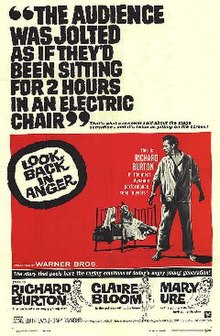
Look back in Anger written by John Osborne fits the features of this kind of theater, especially because of the main character, Jimmy Porter, an angry young man, who is clever and an educated man from a working class. 

Jimmy Porter is a 25 year-old man with a college education and from lower-middle class, represents the frustrated generation of 1950s, married Alison an upper-middle class womanfrom a Victorian family.

In addition, the similarity between Osborne's life and Jimmy Porter can be reflected in the play because of the class, the opportunities that they have had in life and the post war mind, but also, the consistent and often sarcastic criticism of the British life.

We can realize that those Victorian attitudes were the focus to attack from Jimmy who was always insulting her with strong sentences and showing his rebellious attitude to her when he used to call her “Lady Pusillanimous” only because she did not express angry as he used to do and she seemed to be uninterested, he tells her that she is incapable to think. Because of that, we can think that Jimmy hates his wife because of the way he treats her. He even said to her that he wishes that she could have a child and then it will die just because he wondered a recognizable human and being herself. 
 

But also, Jimmy shows lack of interest when Alison leaves the home to go to her parents' house. He doesn't show being in love with her, he does not even care about it considering Helena replaces Alison in the third act by doing the same she used to do, iron his shirts and being there for his necessities. Therefore, he does not care about who has that role, only having someone who can do that. In that way, it produces a cycle.

Also, the characters of this movement are characterized by a class in conflict of their lives, no fitting in the way they live and also not being accepted by the upper middle classes which is the case of Jimmy considering his wife's family was discontent of the fact that Jimmy and Alison married and they did not accept him.

We can conclude this with Jimmy was angry and frustrated with the past which was the old generation (Burgeous class) because they were always complaining about the difference of classes. He is presented as a hero but I think is presented at the same time as anti-hero since he complains all the time but he does not do anything about it, only showing the fact he is not happy with his life. We can see him through the play only trying to destroy the relationship with his wife and showing the pain of being alive.

But at the same time, he can be seen as hero since you wonder if you are living the life that you really want, or you are just used to it and whether you are doing what you really want to do. He makes the reader to think about themselves and questioning of the real “happiness” and what it means.

Look back in anger is a play which represents the “Angry theater” in 1950s which wanted to transmit a more honest and realistic theater and the discontent from the people. This theater was not afraid of telling how the authors characters felt about the world. It related to working class which makes it to be more realistic. The theme is the social critic against the middle class values.

A universe of contradictions.


Adolescence is usually one of the most confusing periods in everybody's life. In a place between the good old days and a promising future, the real fight occurs when dealing with other people's expectations, society's order and ways, and the need for staying true to oneself. The Catcher in the rye, by J. D. Salinger, is a novel about Holden Caulfield, a 17-year-old boy who tells the story of some past events that reflects his own conceptions and perceptions of life and the world.

Holden's experiences and interpretations of them allows us to see and understand his personal conflicts when interacting with a world of appearances and contradictions. These same contradictions present not only in the world around him, but also in himself are the decisive aspects that will shape the way the story evolves. Is this situation, Holden's inner conflicts and possible immaturity, what makes him an unreliable narrator? Or is it his quality of character in the story which may limit his point of view?

From an early start, we can somehow evidence his attitude towards many things, his family, adults and cynical people, and appearances. For example, he starts by saying:

“If you really want to hear about it, the first thing you'll probably want to know is where I was born, and what my lousy childhood was like, and how my parents were occupied and all before they had me, and all that David Copperfield kind of crap, but I don't feel like going into it, if you want to know the truth.”

He seems not to like very much the idea of telling the reader about his story, but we get the idea that he will do it anyways. This careless, almost as if uninterested and childish attitude will remain along the novel, showing his inability to face his own conflicts and the avoidant features in his personality. Further in the same chapter, we learn his dislike for many things. One of them is “phony” people pretending to be something they are not; however, the more we go on through the book, the more we realize the “good” liar he is, and how he uses this ability to, in a way, distance himself from people around him in his journey and search for honest and supporting interactions.

Another important subject in the novel is the way he deals with, or his stand on sexuality, his own sexual drives and emotions, and his judgment of other people's actions on the matter. After finishing the book, it is evident that this is a recurrent subject in Holden's mind. In his interactions with other characters such as Stradlater, a “sexy” roommate of his at Pencey; Jane, his old “crush”; Sunny, the prostitute he hired at the hotel; and Sally, the he met some time before and who he dated later on in the story, we can notice that sexuality, attraction and affection are thing frequently present in his mind. We get the feeling that his sexual urges are constantly haunting him because of his contradictory thoughts. He seems to believe that sexuality and love are two different things, and he is not able to fully grasp or properly act on any of the two. When interacting with Stradlater, his roommate, he criticizes both Stradlater's “phoniness” when trying to “get” girls, and the looseness which he lives his sexuality with.

Furthermore, we could say that an important duality in the story, and Holden himself, is represented by two members of his family, D.B., his older brother, and Phoebe, his young sister. They are two important characters in Holden's life, representing opposing moments and views in life. On the one hand, Holden seems to care for and admire his older brother, but somehow he feels he became part of the adult world he greatly despises. For instance, the first time he refers to his brother he says “Now he's out in Hollywood, D.B., being a prostitute.” On the other hand, When referring to Phoebe, he is always suggesting that she is an adorable, friendly, and trustworthy kid. She seems to be the only person he is able to go to when needing real advice or just when looking for comfort.

Moreover, I personally believe this same duality is reflected in Holden's own personality. His longing for the past, the innocence and honesty of childhood, his fear of the future and adulthood with possibility of becoming something he hates, and his desire for stopping time and avoid his own evolution and change. However, we can make a clear distinction between Holden who is telling the story, specially at the end of the book, and the version of himself in the past when going through all the events. Even though he may still have some difficulties when dealing with the world, he seems to have learned and grown up a little bit, finding in his sister Phoebe the support and the feeling he was looking for, the feeling of being held in familiar and comforting arms of a family.

References


  • Salinger, J. D., Mitchell, E. M., & Jacobi, L. (1951). The Catcher in the Rye.